One of Energy Vision’s longstanding priorities is reducing food waste to promote sustainability and cut methane emissions. EV is part of the New York Food Waste Action Network, whose top priority, the Food Date Labeling Act (FDLA), passed the legislature in early June, in part thanks to our repeated outreach to legislators.
The FDLA will cut through the current unregulated plethora of confusing food labels like “Sell by.” Instead, it will limit the acceptable labels on food products to “Best if Used by” (indicating the quality date of the food item) and “Use by” (indicating the safety date of the food item), based on scientifically valid methods to estimate those dates.
The FDLA also requires the NY Department of Environmental Conservation to conduct education and outreach activities to consumers, retailers, and food donation groups. Together, these measures will result in more edible food being eaten or redistributed rather than landfilled. This crucial steppingstone on the way to reaching zero food waste is now awaiting the governor’s signature, along with many other bills that were passed late in the legislative session.
In our new report, The Future of Shipping: Cleaner Fuel Options for the Maritime Sector, we found some major, emerging opportunities to adopt much cleaner fuels, and momentum is growing.
Across the US, millions of Americans marked our country’s 250th birthday in red, white, and blue. But record heat — temperatures above 100 degrees and heat alerts nationwide — forced the cancellation of parades and celebrations in major cities, including Philadelphia and our nation’s capital.
At the end of every school day at Rye Country Day School (RCDS) in Rye, New York, the school food service staff collects approximately 150 pounds of scraps from food preparation areas, along with food waste from the lower, middle, and upper school lunch cafeterias.
RCDS Students Learn Firsthand How to Eliminate Their School’s Food Wastes
At the end of every school day at Rye Country Day School (RCDS) in Rye, New York, the school food service staff collects approximately 150 pounds of scraps from food preparation areas, along with food waste from the lower, middle, and upper school lunch cafeterias.
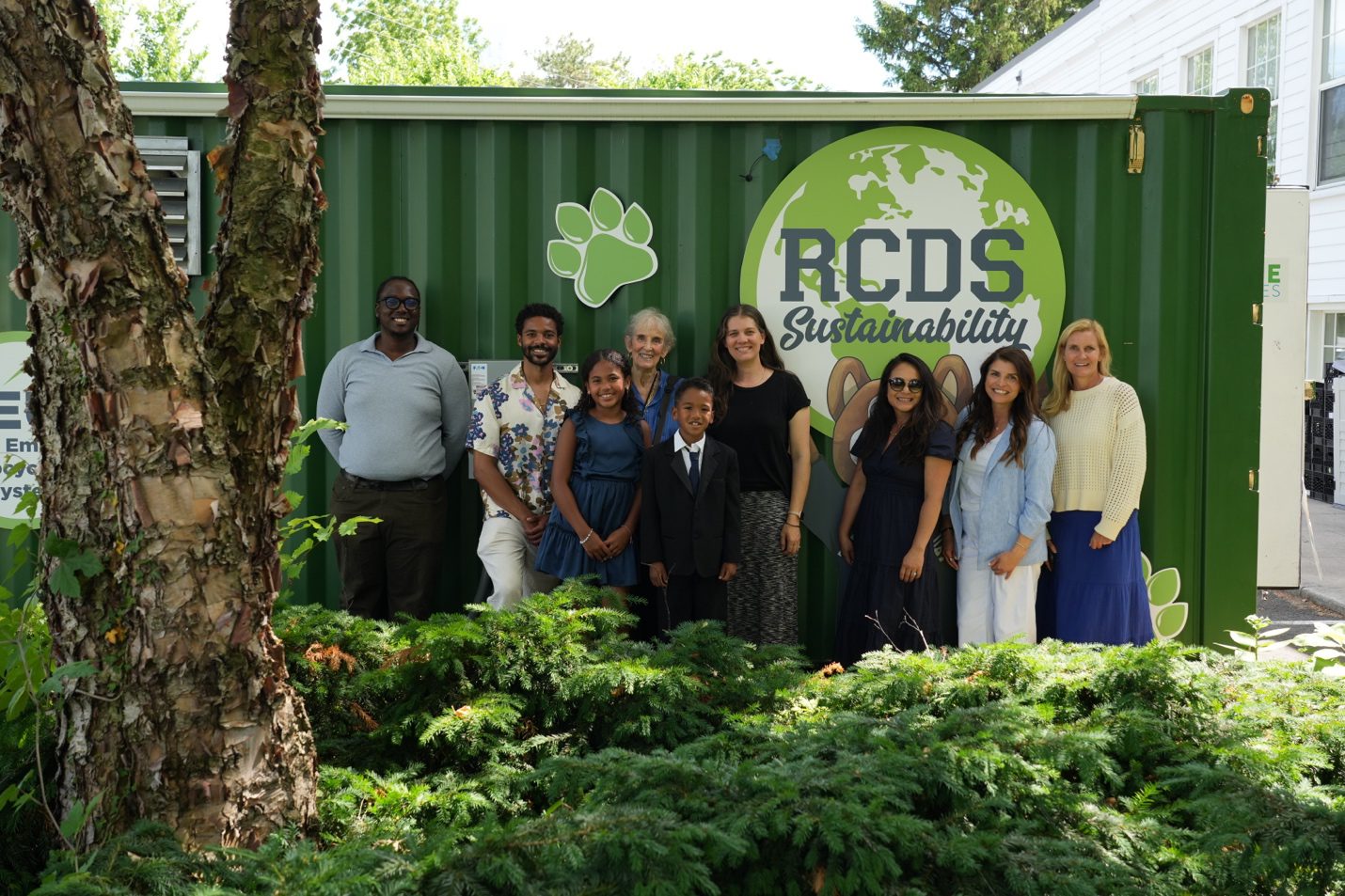
Standing at the side of the ZEUS Digester. Back row: Max Thoby, Regional Systems Operator, Kyle Wyche, COO of Ecotone Renewables, Joanna Underwood and Kerry Linderoth, RCDS Director of Sustainability. Front row: Two RCDS students and their mother, Tracy Wei Joseph, Lynette Gioffre, Director of Advancement and Melissa M. Wirth, Director of Alumni Relations. Photo credit: Kaitlin Moore.
These organic materials are taken to an anaerobic digester located just outside the kitchen. About the size of a single parking space, the unit processes the school’s food waste on site. It is called ZEUS (Zero Emission Upcycling System).
Joanna Underwood, Energy Vision’s Founder and a graduate of Rye Country Day, was invited to come see the digester. “It is an exciting project,” she said, “advancing a critical technology of the future as our country struggles with the dual challenges of waste and climate change.”
The ZEUS digester was built by the Pittsburgh-based firm Ecotone Renewables. Inside the system, these organics are transformed into a liquid plant food called Soil Sauce. It has been certified for organic use by the nonprofit Organic Materials Review Institute (OMRI), ensuring that it complies with the strict standards of the USDA National Organic Program. The plant food is now being distributed to students, families, and employees for use in their home gardens, as well as local garden clubs. Soil sauce is also used in the school vegetable gardens and in classroom science experiments.
The project was undertaken primarily for its educational value to Rye Country Day students. While the plant food is currently being given away, members of the School’s Environmental Club are exploring future opportunities for community use and distribution. Ecotone is also exploring ways to capture and utilize the small amount of biogas generated during the process, which represents approximately 138 tons of CO₂ equivalent annually.
The digester was made possible through a generous gift from parents of Rye Country Day students, and their donation also covered the system’s first year of maintenance. While maintaining the ZEUS digester costs more than the school’s previous composting service, its educational benefits and alignment with the RCDS sustainability initiatives make it a worthwhile investment for any organization with a dedication to environmental stewardship. According to Kerry Linderoth, Director of Sustainability at RCDS, “The anaerobic digester provides students with a hands-on opportunity to learn about food waste, renewable energy, nutrient recycling, and the circular economy. It serves as a living laboratory that supports the school’s commitment to sustainability as a key pillar of education.”
Dr. Stacey Sotirhos, Interim Head of RCDS, Joanna Underwood, and Kerry Linderoth, RCDS Director of Sustainability, behind the ZEUS digester. Photo credit: Kaitlin Moore.
Ecotone Renewables has launched a major five-digester program at the University of Pittsburgh and has deployed an additional eleven digesters across the country. These systems offer an innovative solution for schools, universities, hospitals, commercial kitchens, breweries, small businesses, and other organizations seeking to put their organic waste to productive use. And for interested customers, the company provides an analysis of how sales of Soil Sauce (handled by Ecotone) can make these digester projects profitable.
In our new report, The Future of Shipping: Cleaner Fuel Options for the Maritime Sector, we found some major, emerging opportunities to adopt much cleaner fuels, and momentum is growing.
Across the US, millions of Americans marked our country’s 250th birthday in red, white, and blue. But record heat — temperatures above 100 degrees and heat alerts nationwide — forced the cancellation of parades and celebrations in major cities, including Philadelphia and our nation’s capital.
One of Energy Vision’s longstanding priorities is reducing food waste to promote sustainability and cut methane emissions. EV is part of the New York Food Waste Action Network, whose top priority, the Food Date Labeling Act (FDLA), passed the legislature in early June, in part thanks to our repeated outreach to legislators.
Founder’s Column: As America Celebrates, Nature Lays Down the Gauntlet
Across the US, millions of Americans marked our country’s 250th birthday in red, white, and blue. But record heat — temperatures above 100 degrees and heat alerts nationwide — forced the cancellation of parades and celebrations in major cities, including Philadelphia and our nation’s capital.
In Washington, the evening’s marquee event was pushed back nearly to midnight, delayed by the heat and a major storm. It was hard not to read it as a warning: nature marking our milestone with a reminder of the work still ahead.
The warning wasn’t limited to the US. Record-breaking heat waves swept Western Europe — Spain, Portugal, France, and the UK — triggering wildfire evacuations and excess deaths.
On a day meant to celebrate 250 years of American progress, nature gave us a pointed reminder of an abiding challenge — and a nudge to move faster on using the solutions we’ve already developed. If we want to safeguard this country for the next 50 years, and the 50 after that, the tools are here. We just need to use them.
This edition of EV News highlights two of them.
On the international stage, the world’s largest tanker ships need to take real steps forward, with cleaner fuels available today. Closer to home, Rye Country Day School in Rye, New York, has installed an anaerobic digester on campus that turns its food prep and cafeteria wastes into clean organic plant food — while teaching students firsthand about waste, its climate impact, and a solution ready to be replicated by thousands of schools, universities, breweries, and more across the country.
A Nation Built on Solving Big Problems
America’s 250-year story has been one of building what didn’t exist yet — from the interstate highway system to the internet. The tanker fleet and the school cafeteria in this edition are two examples of innovation today: the technology to turn our waste streams into secure, clean, domestic energy isn’t a future promise. It’s operating right now, at the scale of a single school and of global shipping. The question ahead of us isn’t whether these solutions work. It’s whether we choose to put them to use fast enough to matter.
The choices made by school boards, city councils, business owners, and voters is where the story of the next 250 years get written. Energy Vision remains committed to advancing these solutions, and to helping communities and institutions across the country implement them.
Putting America’s organic waste to work — turning it into compost and clean renewable natural gas — is, like solar and wind, a secure domestic resource, available here and now. Every American can make a difference by encouraging local governments, businesses, and institutions to adopt these solutions, and by supporting leadership that treats the climate challenge of our time with the urgency it deserves.
In our new report, The Future of Shipping: Cleaner Fuel Options for the Maritime Sector, we found some major, emerging opportunities to adopt much cleaner fuels, and momentum is growing.
At the end of every school day at Rye Country Day School (RCDS) in Rye, New York, the school food service staff collects approximately 150 pounds of scraps from food preparation areas, along with food waste from the lower, middle, and upper school lunch cafeterias.
One of Energy Vision’s longstanding priorities is reducing food waste to promote sustainability and cut methane emissions. EV is part of the New York Food Waste Action Network, whose top priority, the Food Date Labeling Act (FDLA), passed the legislature in early June, in part thanks to our repeated outreach to legislators.
New EV Report Charts Course for Cleaner Maritime Fuels
In our new report, The Future of Shipping: Cleaner Fuel Options for the Maritime Sector, we found some major, emerging opportunities to adopt much cleaner fuels, and momentum is growing.
Shipping is the backbone of the global economy, with over 106,000 commercial vessels moving 90% of all internationally traded goods. Maritime is one of the hardest sectors to decarbonize, as ships often travel long distances, have limited onboard fuel storage and refueling opportunities, and need energy-dense fuels. So almost all run on fossil fuels – heavy fuel oil (HFO), marine diesel oil (MDO), and marine gas oil (MGO) – which are relatively cheap but have high greenhouse gas (GHG) emissions.
If the maritime sector were a country, it would rank among the top seven global greenhouse gas emitters.
But in Energy Vision’s new report, The Future of Shipping: Cleaner Fuel Options for the Maritime Sector, we found some major, emerging opportunities to adopt much cleaner fuels, and momentum is growing. Addressing this issue is urgent. The International Maritime Organization (IMO) forecasts that maritime trade could increase 40-115% by 2050 compared to 2020. Furthermore, most of the raw materials and finished goods necessary for the global clean energy transition – from rare earth minerals to wind turbines – will ultimately be transported by ship.
While the maritime capacity that is necessary to carry out the global clean energy transition has often been overlooked or underestimated, it will have to grow substantially, right as pressure accelerates to decarbonize shipping.
A suite of low-carbon alternatives are now gaining real traction for long-distance shipping, although high costs and limited availability remain major hurdles. (See chart below for GHG reductions of each fuel.) These fall into three categories:
Renewable diesel (RD) and biodiesel are considered “first generation” options. They are made from organic fats and oils, processed with hydrogen under high heat and pressure. These liquid drop-in fuels are compatible with existing engine infrastructure.
Bio-liquefied natural gas (bioLNG) and biomethanol. These are called “second generation” fuels. Bio-liquefied natural gas (bioLNG) is made by capturing the methane biogases from decomposing organic waste in anaerobic digesters and landfills, purifying them into renewable natural gas (RNG), and then super-cooling it into a liquid fuel. Biomethanol can be made from a wide variety of crops and plant wastes. While both of these fuels require new engines (primarily dual-fuel with diesel), they are increasingly being deployed.
Green hydrogen, greenammonia, and e-fuels. These “next generation” fuels are made with renewable electricity and captured CO2. Apart from e-diesel, they not only require their own dedicated engines or dual-fuel engines with diesel, but they also face many challenges with cost and scalability.
Regulatory pressure is increasing to speed up the pace of alternative shipping fuel adoption from the European Union and, to a less certain degree, the International Maritime Organization. Out of the over 106,000 commercial ships worldwide, just over 1,300 vessels currently run on alternative fuels such as LNG or methanol. But the totals are rising each year, as are the available volumes of low carbon, bio-based versions of those fuels, such as bioLNG and biomethanol.
Every non-petroleum fuel option involves tradeoffs relative to cost, emissions performance, infrastructure requirements, and scalability.
Low-carbon biofuels, particularly first and second generation options like RD, bioLNG, and biomethanol, offer the most feasible near-term pathways for significant emissions reductions. While they face challenges and tradeoffs, they are available, deployable now, and are already proven at scale on some of the most demanding trade routes in the world. For example, shipping giant Hapag-Lloyd, which transports cargo all over the world, offers customers the option of paying a premium to cut their GHG emissions by having their containers shipped using 25%, 50%, or 100% biodiesel. Maersk, another shipping giant, has invested heavily in both methanol- and LNG-fueled ships, securing contracts for large-scale biomethanol and bioLNG supplies.
Hapag-Lloyd offers customers the option to cut GHGs by paying a premium to have their cargo shipped using 25%, 50%, or 100% biodiesel. (Photo credit: Tvabutzku1234/Wikimedia Commons, Creative Commons 1.0)
Next generation fuels like green ammonia are still years and billions of dollars away from being ready at the necessary scale, but they are expected to grow in importance through the 2030s and beyond as policy support, infrastructure, and markets mature.
Notably, Energy Vision’s report found that fuels derived from food waste and livestock manure – including bioLNG, biomethanol, and green ammonia – provide the deepest lifecycle emissions reductions (see chart below), though at higher costs today than fuels derived from other organic feedstocks.
“Well-to-Wake” Lifecycle Greenhouse Gas Emissions for Each Fuel
Source: Energy Vision chart using data from GREET 2025, measured in grams of carbon dioxide equivalent per Megajoule (gCO2e/MJ).
The Future of Shipping features case studies of the progress being made in the private sector. Many leading global consumer product companies, including Amazon, Patagonia, and Nestlé, as well as major shippers like Maersk, Hapag-Lloyd, Fortescue, United European Car Carriers, and others are stepping forward, embarking on their own clean fuel programs. Challenges and tradeoffs are prevalent, but so are emerging solutions, including ways to cut problematic “methane slip” (the unintentional release of small amounts of methane during combustion) from LNG engines.
The financial challenge to alternative fuel adoption may be less daunting than it appears, especially when large, high-profile companies choose to take the lead, such as through the Zero Emission Maritime Buyers Alliance (ZEMBA). And shipowners don’t necessarily have to be on the hook for covering all the extra costs.
Energy Vision calculated that a few additional cents per end consumer product shipped could translate into thousands of tons of avoided emissions. For example, we calculated that the costs of one of the more expensive cleaner fuel options for a trans-Pacific cargo shipment could easily be covered by 12 cents per pair of sneakers (given that a typical container can carry ~2,500 shoeboxes) or less than a quarter of a cent per smartphone (since a typical container can carry hold ~100,000 boxed smartphones).
The EU currently has the most stringent maritime decarbonization regulations in the world, with penalties tightening over time for GHG emissions. This is already driving real action in the sector, with orders for alternative-fueled ships rising each year.
But even outside the EU, some form of binding maritime emissions requirements are likely to come in the future. This may come next in other regional/national jurisdictions and eventually at the global level through the IMO. Nevertheless, fleet owners are now facing a fundamental choice: bear the escalating costs of non-compliance – and inherent price volatility associated with petroleum-derived fuels – each year or invest now in vessels that will have much lower emissions over their 30-year operational lifespans.
As Energy Vision’s report makes clear, there is no silver bullet solution; every non-fossil maritime fuel option has its own particular tradeoffs. Ultimately, accelerating maritime decarbonization will require a portfolio approach grounded in first and second generation biofuels alongside continued investment and innovation in next generation alternatives. With the right combination of policy support, private sector leadership, and innovative financing, a cleaner maritime sector is both technically achievable and economically viable.
The Future of Shipping was authored by Energy Vision’s Director of Research and Publications Michael Lerner and Addie Wiener, a 2025 summer intern who was entering her senior year at Vassar College.
Across the US, millions of Americans marked our country’s 250th birthday in red, white, and blue. But record heat — temperatures above 100 degrees and heat alerts nationwide — forced the cancellation of parades and celebrations in major cities, including Philadelphia and our nation’s capital.
At the end of every school day at Rye Country Day School (RCDS) in Rye, New York, the school food service staff collects approximately 150 pounds of scraps from food preparation areas, along with food waste from the lower, middle, and upper school lunch cafeterias.
One of Energy Vision’s longstanding priorities is reducing food waste to promote sustainability and cut methane emissions. EV is part of the New York Food Waste Action Network, whose top priority, the Food Date Labeling Act (FDLA), passed the legislature in early June, in part thanks to our repeated outreach to legislators.
Harrisburg, PA Sets the Pace, Making Its Wastewater Plant an Energy, Economic, and Climate Winner
Not a city or community in the US could sustain its quality of life without a plant to process its wastewater. There are more than 15,000 of these wastewater plants in the US today, and more than 1,100 process at least 5 million gallons of sewage a day.
This subset — critical urban and suburban infrastructure — could process local food waste along with that sewage. They could then turn the methane biogases emitted by all these organics into clean energy or fuel. Capital Region Water’s facility in Harrisburg, PA is a shining example for what can be done.
Municipalities across the United States are grappling today with aging infrastructure, rising costs, and increasing pressure to reduce their emissions. And with the right combination of partners and municipal leadership, using innovative solutions, they can turn their existing wastewater infrastructure from liabilities into assets.
Capital Region Water (CRW), a municipal authority serving the Harrisburg region, operates a facility capable of processing tens of millions of gallons per day. But like many wastewater utilities, CRW historically treated the biogases emitted by its decomposing organics, as something it needed to handle, but that was of little value. For years, CRW had an energy recovery system at the plant. However, after decades of operation, the system was nearly inoperable.
Then, as part of a larger plant upgrade process, CRW found that its infrastructure could be modernized so that the methane biogases the plant generates could be captured and upgraded into pipeline-quality renewable natural gas (RNG). It also had the potential to accept regionally abundant food wastes (think chocolate bars and potato chips). These could be co-processed with the sewage, bolstering energy production and maximizing its economic benefits while also advancing climate and sustainability goals.
Turning that opportunity into a viable, operational project required more than just technology—it required leadership, coordination, and a significant investment over the course of seven years from initial concept to reality.Over these years, Energy Vision played an important role in bringing this $27 million project to fruition. It was an exciting initiative for the CRW and for us.
From the outset, Energy Vision played a central role in helping Capital Region Water define and execute a strategy that maximized value while minimizing risk. In close collaboration with the global engineering firm, Arcadis, this included evaluating technology pathways, identifying optimal commercial structures, navigating incentives and policy frameworks, and helping select the right partners.
Equally important, we were able to translate a technically complex concept in a way that municipal leaders could understand – clarifying the benefits in terms of infrastructure, energy markets,environmental progress, and public finance.These domains are often “siloed” within municipal organizations.
The Harrisburg Capital Region project became operational in December 2025 achieving multiple benefits. It not only generates more renewable energy. It will also strengthen the financial position of the utility, reduce greenhouse gas emissions, and divert local organic wastes from landfills.With an expected payback of under six years, this project is not just a success story—it is a blueprint for replication in municipalities across the country.
In January, Energy Vision welcomed two new board members who bring a wealth of experience and expertise in renewable energy, low-carbon fuels and clean transportation.
Former NYC DEP Commissioner Rit Aggarwala and Energy Vision Founder Joanna D. Underwood at the Newtown Creek RNG project unveiling in May 2023.
EPA has proposed to rescind the long-standing “endangerment finding”—the legal foundation that has enabled federal regulation of greenhouse gas emissions since it was affirmed by the Supreme Court in 2009. If finalized, EPA’s change would shift much of the responsibility for regulating these emissions back to the states.
The response has already been swift and far-reaching. Coalitions of cities, states, attorneys general, and public health advocates have mobilized across the country—many in opposing this move but some in support—underscoring just how central climate policy has become to economic, environmental, and public health priorities nationwide.
At the same time, the broader climate challenge continues to intensify. In the US and globally, greenhouse gas concentrations in the atmosphere continue to rise, driven largely by reliance on fossil fuels. Most important is the rise in methane gases which have a planet warming potential more than 80 times that of CO2 and which climate scientists have said must be reduced 30% by 2030 if the catastrophic impacts of “runaway climate change” are to be avoided. And global events—especially the ongoing conflict in Iran and its associated targeting and destruction of major fossil fuel assets in the Middle East—are compounding these impacts in ways that are already recognized as deeply consequential.
Yet, in the face of these challenges, one thing is becoming increasingly clear: renewable solutions that are practical, scalable, and economically viable exist today. And they should no longer be considered optional—they are essential; now more than ever.
At Energy Vision, we remain focused on one of the most immediate and underutilized opportunities available today: transforming this country’s huge organic waste stream into renewable energy. Across the U.S., vast amounts of food waste, agricultural residues, and wastewater solids are emitting methane into the atmosphere as they rot. By capturing these emissions in “anaerobic digesters” and upgrading them into renewable natural gas (RNG), we can both reduce climate impacts and produce a low-carbon fuel that can directly replace diesel with its toxic emissions in heavy-duty transportation.
This is not a distant or theoretical solution—it is happening now.
In this issue, we highlight a powerful and exciting example: the wastewater RNG project at Capital Region Water in Harrisburg, Pennsylvania, which is entering operations this month. It is a model for what can be achieved—one that can be replicated at more than a thousand wastewater facilities across the country.
Energy Vision has been proud to help bring this project and others like it to life, working alongside municipalities, developers, and industry partners to turn complex ideas into real-world outcomes. According to Jess Rosentel, COO for Wastewater at Capital Region Water in Harrisburg: “Energy Vision was instrumental in helping us turn an early and unfocused concept into a successful, now operational wastewater RNG project. From the outset, their deep understanding of how to maximize the value of biogas and minimize risk—across technology, incentives, markets, and policy—shaped our decisions and helped us select the right partners. Their leadership brought clarity, confidence, and momentum to a complex effort, and the project would not have moved forward as effectively without their involvement.”
At a moment when the path forward on climate policy may feel uncertain, the importance of grounded, actionable solutions like these has never been greater. There is much more to be done—but there is also real progress underway.
We are grateful for our supporters who have made our work possible, and we invite you to join us in exploring if and how this strategy might be advanced in your city or community as every new initiative will mean progress toward a cleaner, healthier energy future.
Not a city or community in the US could sustain its quality of life without a plant to process its wastewater. There are more than 15,000 of these wastewater plants in the US today, and more than 1,100 process at least 5 million gallons of sewage a day.
In January, Energy Vision welcomed two new board members who bring a wealth of experience and expertise in renewable energy, low-carbon fuels and clean transportation.
EV Founder and Trustee Joanna Underwood poses with Manhattan Beer Fleet Director Juan Corcino in front of a new truck equipped with a Cummins X15N natural gas engine now being fueled by RNG which is stored in the cylindrical tank.
The company bought the first commercial fleet of natural gas trucks (rather than diesel) back in 2001 to help reduce local air pollution. They built a refueling station on their property. This move was inspired by the fleet manager, Juan Corcino, whose children suffered from asthma.
Now, Manhattan Beer has taken another step forward. The company has purchased 17 large heavy duty trucks equipped with the new X15N engine, produced by Cummins. It is the first engine enabling the heaviest trucks to also leave the diesel era behind. And they will run on renewable natural gas (RNG) rather than fossil gas. The role of RNG is especially important in New York City. Produced from the methane that has been captured from landfills, wastewater, and organic waste, it slashes their greenhouse gases while also delivering meaningful improvements in local air quality—particularly in communities that have long borne the burden of diesel truck pollution.
Juan Corcino and Joanna Underwood showed the truck off at the clean vehicles event in New York’s Union Square, and the 17 trucks will go into operation in April.
Manhattan beer has also expanded its use of smaller electric-battery vehicles. Its strategy is simple: use what works and act now. In doing so, the company is proving that fleet decarbonization isn’t a future concept—it’s already happening in a big way even on the streets of New York. This company continues to lead one of the most practical and effective fleet decarbonization efforts in the country.
Not a city or community in the US could sustain its quality of life without a plant to process its wastewater. There are more than 15,000 of these wastewater plants in the US today, and more than 1,100 process at least 5 million gallons of sewage a day.
In January, Energy Vision welcomed two new board members who bring a wealth of experience and expertise in renewable energy, low-carbon fuels and clean transportation.
In January, Energy Vision welcomed two new board members who bring a wealth of experience and expertise in renewable energy, low-carbon fuels and clean transportation.
Charles E. Love, Jr. (right) leads the renewable fuels portfolio for Love’s Alternative Energy, part of the Love’s family of companies. Love’s Travel Stops & Country Stores—one of the largest privately held companies in the U.S.—operates more than 650 locations across 42 states, delivering comprehensive fueling solutions for heavy-duty fleets, including RNG, EV charging, and other emerging energy technologies.
Charles focuses on advancing RNG and hydrogen opportunities with partners across the waste, transportation, and agricultural sectors, including municipalities, trucking fleets, waste haulers, and wastewater and landfill operators. He is a strong advocate of real-world, clean fuel solutions.
An entrepreneur from an early age, Charles launched his third company at age 21 before transitioning into renewable energy. He is a graduate of St. Gregory’s University and lives in Austin, Texas with his family. One of Charles’ driving beliefs is that turning waste into renewable energy is one of the most practical and impactful ways to build a low-carbon future.
Ted Niblock (left) brings more than two decades of leadership at the intersection of renewable energy development, policy, and environmental markets. He currently serves as Vice President of Development at Nexus W2V, advancing waste-to-value infrastructure projects across the U.S.
Ted has held senior roles across the biogas and organics recycling sector, including Chief Development Officer at Ductor Oy, and President of NewAg Development.
Earlier in his career, he served as General Counsel and Director of Government Affairs for multiple renewable energy companies, helping shape projects and policy frameworks during the early growth of the U.S. biogas industry. A recognized voice in the sector, Ted was a longtime columnist for BioCycle. He holds a J.D. from Boston University School of Law and a B.A. from Johns Hopkins University. He lives in Washington, DC with his family.
Not a city or community in the US could sustain its quality of life without a plant to process its wastewater. There are more than 15,000 of these wastewater plants in the US today, and more than 1,100 process at least 5 million gallons of sewage a day.
FedEx Freight is one of the first major carriers to adopt the new Cummins X15N engine fueled by RNG.
Divert’s Turlock, CA AD facility produces RNG from recycled food scraps.
Their work has set new benchmarks for leveraging organic “waste” as a valuable renewable resource, including rescuing edible food, generating clean, low-cost, renewable domestic energy and new revenue streams, and cutting emissions of methane and other climate pollutants.
Divert, Inc.,a U.S. company, headquartered in New Concord MA,was founded in 2007 to assist the grocery industry in preventing food waste – specifically helping it meet the United Nations and US objectives of cutting food waste 50% by 2030. According toChris Thomas, VP of Public Affairs, Divert works with its customers to facilitate redistribution of edible food that would otherwise get thrown away. But it also is building plants to take the inedible, non-donatable food wastes which can then be processed into carbon -negative renewable natural gas (RNG) and fertilizer. Divert is working with almost 8,000 food retail stores, large food manufacturers, and distributors around the country. Its partners include Kroger, Albertsons, CVS, Blue Diamond Growers, United States Cold Storage and more. The company has so far served 14 million meals of rescued food andprocessed 3.3 billion pounds of unsold, non-donatable food that would otherwise have been landfilled.
Cummins, Inc. received its award for introducing a new compressed natural gas engine in 2025 – “the X15N™. This is the first 15-liter CNG engine that at last is enabling the heaviest duty trucks, and those involved in long-haul trucking, to end their reliance on diesel fuel, whose emissions threaten the health of millions of Americans. These new trucks can be powered with clean burning renewable natural gas fuel — the lowest carbon fuel available today.
FedEx Freight, our third awardee – and one of the largest national logistics providers, is buying trucks equipped with Cummins new X15N™ engines for use in its fleets and fueling them with RNG. “According to Joe Oleson,Managing Director of Fleet Maintenance, Support & Equipment for FedEx Freight. “ we worked with Cummins to adapt their 12-liter natural gas engine, and now we’re very optimistic about what the X15N™ can offer.”
EnviTec Biogas AG, a German-based companyreceived its award as a global leader in the design, construction and operation of anaerobic digesters and of gas upgrading equipment. EnviTec has built more than 800 anaerobic digester and gas upgrader systems worldwide. It owns and operates 91 of them, including one near Syracuse, New York.EnviTec’s facility in Güstrow, Germany is among the most advanced in the world. It not only processes enough biogas to power the entire plant with renewable energy, but it produces liquefied renewable natural gas (L-RNG) for heavy-duty trucks; beverage grade biogenic CO2, and soil nutrients for local agriculture.
Durwood Zaelke, our final awardee, received a lifetime achievement award as a leading climate scientist, author and activist. Zaelke isfounder and president of the Institute for Governance and Sustainable Development (IGSD), a leading voice on the need for a binding global agreement to cut methane emissions. According to Zaelke, “This is the fastest way to turn down near-term warming.”We have many promises and pledges: the Global Methane Pledge signed by 159 countries; the Global Methane Hub; and the Oil and Gas Decarbonization Charter from COP28.But promises and pledges are not always kept.It’s time to move to mandatory measures.”
“It’s easy to talk about commitments and goals for methanereduction by 2030 or 2050; but it’s a lot harder to actually do it,” said Matt Tomich, Energy Vision’s President. “The cost of everything has gone up, and it’s a time of uncertainty in policy and markets. But it’s also a time of great opportunity. So we’re happy to honor the leaders who are out there actually making it happen.”
Not a city or community in the US could sustain its quality of life without a plant to process its wastewater. There are more than 15,000 of these wastewater plants in the US today, and more than 1,100 process at least 5 million gallons of sewage a day.
In January, Energy Vision welcomed two new board members who bring a wealth of experience and expertise in renewable energy, low-carbon fuels and clean transportation.
EV Report Shows Landfills Can Slash Methane Emissions While Earning New Revenue
Landfills are the third-largest source of U.S. methane emissions, and Energy Vision’s new report, Leading with Landfills, shows that these emissions can be cut significantly by adopting commercially available technology that would improve landfills’ bottom lines.
In fact, if the nearly 900 feasible candidate municipal solid waste landfills in the US adopted these technologies, it would cut their emissions in half. That would reduce total US methane emissions by 7.2% (49.4 million metric tons of CO2 equivalent) relative to the 2023 level.
In light of the 2021 agreement by international climate scientists that global methane emissions must be cut 30% by 2030 to avoid catastrophic planetary warming, there is a compelling reason for landfills to adopt these economic strategies right away.
At present, many landfill gas capture systems are very inefficient and have large gaps in coverage. They typically don’t include working faces, where decomposing food wastes release methane in the first few years – before those areas are closed and gas capture systems are eventually installed. Furthermore, some high-emitting landfills have no gas capture systems at all.
Energy Vision identified the top three most impactful strategies for capturing more landfill methane, preventing it from escaping into the atmosphere. This methane can then be put to beneficial use, to produce renewable natural gas (RNG) or generate electricity. The strategies include:
“Real-time tech” – using real-time monitoring and automated wellhead tuning technology to improve the efficiency of existing landfill gas collection systems.
“Early action” – installing gas collection systems much earlier at landfill working faces (in time to capture the methane-rich biogas from decomposing food waste).
“New gas capture systems” – building gas collection systems at high-emitting landfills that lack them and which are not required to install them under current lax regulations.
Energy Vision refers to these three options as “advanced landfill tech,” and they are all extremely cost-effective. Based on the advanced landfill tech equipment having an 8-year lifespan, with estimated capital expenses of just $1.3 billion and operating expenses of $250 million annually, the cost comes out to $8.35 per metric ton of CO2 equivalent (MT CO2e) abated. This cost is much lower than many other greenhouse gas reduction strategies (see chart below).
The Lower Annual Cost of Advanced Landfill Tech Per Metric Ton of CO2 Equivalent Abated Compared to Other Climate Strategies
Source: Energy Vision, Leading with Landfills (more details on chart sources available in report).
Energy Vision also calculated that if all food waste were ultimately diverted from landfills, implementing the real-time tech option and new gas capture systems options would still cut 4.1% from total US methane in 2023. This underscores that these advanced landfill tech options are worth implementing even as efforts to divert and redistribute edible food wastes gradually gain momentum.
The business case for adopting advanced landfill tech is very compelling. If virtually all the additional captured gas is converted to RNG and sold as fuel, as the current market incentives strongly favor, then landfills adopting this tech could produce 93 million MMBTU of RNG each year. That would be a roughly 70% increase from the current total national supply (around 135 million MMBTU as of end-2024). Selling this RNG would enable operators to recoup their initial investment within a year of advanced landfill tech equipment coming online, and cumulatively generate gross revenue of $1.86 billion a year thereafter.
There are also many secondary methane mitigation measures worth pursuing at landfills. They include incorporating remote/aerial monitoring of leaks, adopting best practices in cover, and decreasing the spacing between wellheads. In addition, there is almost entirely untapped potential at some industrial landfills, which face no regulatory requirements to install GCCS yet collectively emit almost one fifth of the emissions that MSW landfills do.
Options to accelerate implementation of advanced landfill tech include tighter regulations; direct subsidies; and expanding incentives for beneficial use of gas at landfills implementing best practices for gas capture.
While only a handful of years remain to meet the international goal of cutting methane emissions at least 30% by 2030 (“30×30”), the US can reach this goal by adopting advanced landfill tech, by building 4,700 new anaerobic digesters, and by plugging leaky oil and gas wells (see Energy Vision’s report Meeting the Methane Challenge for more).
In this issue of EV News, you will find new research and exciting strategies that we are identifying and promoting that can enable states to slash their planet-warming methane emissions 30% by 2030.
This summer, Energy Vision partnered with the Arizona Center for a Carbon Neutral Economy to explore the state’s untapped potential for producing renewable natural gas (RNG) from organic waste.
Energy Vision’s latest report examines how Washington can overcome economic and policy hurdles to expand dairy anaerobic digestion, a powerful tool for slashing methane emissions while supporting the state’s climate goals.
Founder’s Column: Making Progress in States Despite a Climate-blind Administration
In this issue of EV News, you will find new research and exciting strategies that we are identifying and promoting that can enable states to slash their planet-warming methane emissions 30% by 2030.
This is the “30×30” goal the US signed onto with 158 other nations on the recommendation of hundreds of the leading climate scientists but that the Trump Administration has walked away from.
The federal government has turned its back on the goals the US set despite the clear evidence that floods, wildfires, droughts, and melting glaciers are causing more and more death and destruction every year. The 2024 hurricane season was the most destructive in US history, causing an estimated $500 billion in damage to property, the economy, and public health. The disastrous floods in central Texas in July were perhaps the most tragic example in the US this year as the warming air from the Gulf of Mexico lead to massive rainstorms raising the Guadalupe River some 28 feet and killing more than 135 – many camping children. But such events have done nothing to convince this climate-blind Administration to accept that we are a facing a true crisis.
On the positive side, Energy Vision remains committed to promoting practical, actionable solutions. Our research is showing that cutting methane emissions from waste and turning these captured gases into clean renewable natural gas (RNG) fuel has major economic and environmental advantages. Energy Vision has expanded our tangible, state-specific guidance from New York to now include Washington State and Arizona. For Washington, we have provided an in-depth analysis of how policymakers there could facilitate a buildout of anaerobic digesters to capture methane from dairy operations. This approach would both make direct progress toward the 30×30 goal and provide crucial economic benefits to farmers as they implement climate-friendly measures (many of which would otherwise be unaffordable).
Meanwhile, our other new report, Leading with Landfills, provides a new, extremely cost-effective approach that every state can use to tackle their emissions from landfills – the third-largest source of US methane. With existing technology and proven techniques, over 900 landfills across the US could capture more of their methane, refine it and sell it as clean RNG, quickly recouping their investment and then some. This would be a quick win at very low cost for every state. And collectively it would cut total US methane emissions by a whopping 7.2%.
Millions of Americans of all political persuasions wanting to see our country thrive economically have reason to raise their voices in support of turning organic waste into renewable energy while cutting methane emissions deeply. Tens of thousands of new jobs can be created to implement these proven strategies to reduce the country’s huge and expensive organic waste stream and reach 30×30. Now more than ever we need cities, states and the private sector to take the lead.
Landfills are the third-largest source of U.S. methane emissions, and Energy Vision’s new report, Leading with Landfills, shows that these emissions can be cut significantly by adopting commercially available technology that would improve landfills’ bottom lines.
This summer, Energy Vision partnered with the Arizona Center for a Carbon Neutral Economy to explore the state’s untapped potential for producing renewable natural gas (RNG) from organic waste.
Energy Vision’s latest report examines how Washington can overcome economic and policy hurdles to expand dairy anaerobic digestion, a powerful tool for slashing methane emissions while supporting the state’s climate goals.
This summer, Energy Vision partnered with the Arizona Center for a Carbon Neutral Economy to explore the state’s untapped potential for producing renewable natural gas (RNG) from organic waste.
Jackson Wallis, one of five Energy Vision summer 2025 interns.
Jack Wallis, a recent graduate of Haverford College, and one of five superb summer interns with Energy Vision, coordinated an assessment of the amount of renewable natural gas fuel that could be produced in Arizona from the organic wastes in the state’s landfills, livestock operations, food wastes and municipal wastewater. The study was a collaboration between Energy Vision and the Arizona Center for a Carbon Neutral Economy (AzCaNE).
The study found that, with ambitious policies, the State could produce enough RNG fuel (44.8 million MMBTU per year) to power around 40,000 tractor trailers (equipped with natural gas engines). The RNG made from captured methane landfill gases may be the most affordable and quickest to ramp up, especially if they adopt the measures outlined in EV’s new report Leading with Landfills. The findings will help inform key public and private sector stakeholders about the significant opportunities Arizona has to cut its methane emissions and become a leader in RNG production.
Landfills are the third-largest source of U.S. methane emissions, and Energy Vision’s new report, Leading with Landfills, shows that these emissions can be cut significantly by adopting commercially available technology that would improve landfills’ bottom lines.
In this issue of EV News, you will find new research and exciting strategies that we are identifying and promoting that can enable states to slash their planet-warming methane emissions 30% by 2030.
Energy Vision’s latest report examines how Washington can overcome economic and policy hurdles to expand dairy anaerobic digestion, a powerful tool for slashing methane emissions while supporting the state’s climate goals.
EV Report Lays Path for Washington State to Cut Dairy Methane Emissions
Energy Vision’s latest report examines how Washington can overcome economic and policy hurdles to expand dairy anaerobic digestion, a powerful tool for slashing methane emissions while supporting the state’s climate goals.
Washington is one of the top ten states for milk production, and dairy is its largest commodity after apples. But state leaders face a quandary: while Washington has been an international leader in tackling climate change, it is far behind California and other states in building anaerobic digesters, the premier way to capture the methane from its dairies. Energy Vision assessed how Washington could stimulate change in its dairy sector, forging ahead toward the all-important global goal – called for by international climate scientists – of slashing methane emissions 30% by 2030 and toward the State’s own goal of 45% total GHG reduction by 2030.
In our report “Market Challenges and Opportunities for Dairy Anaerobic Digestion (AD) in Washington State,” we looked at the problems and possible solutions.
At present, there are only five operational dairy ADs in Washington, down from nine in 2019, and none have been built in the last 10 years. Energy Vision calculated that another 80 dairies in Washington have herd sizes theoretically large enough to support ADs, and constructing them all would cost about $1.2 billion. Doing so would cut the State’s manure methane emissions by a whopping 75%, meaning a reduction of at least 1.2 million metric tons of CO2 equivalent.
EV Findings – It Comes Down to Economics
Under current state policies and market conditions, dairy farmers and AD developers face very unclear economic returns for what would be major upfront investment (of at least several million dollars to build a digester). The going prices for the electricity or RNG that these digesters would produce are currently too low to cover the expenses, even factoring in federal credits where applicable, and the State provides very little in the form of grants or other incentives for dairy ADs.
However, through strategic grants, loans, and other incentives (see below), the State could catalyze significant private capital to reach the full $1.2 billion in capital expenditure rather quickly, and it would be a cost-effective climate strategy.
Energy Vision engaged dairy farmers, AD developers, regulators, and communities to pinpoint the challenges that have severely limited dairy AD adoption in the State. Based on those findings (including detailed surveys from close to 40 dairy farmers and 10 AD developers), as well as policies that have worked well elsewhere, the report provides 10 recommendations for Washington policymakers to facilitate cutting methane through a buildout of dairy ADs.
We found there’s lots of interest in dairy ADs – 73% of respondents have at some point considered using ADs on their dairy farm, and 71% were interested in learning more about AD adoption. Meanwhile, most developers noted that three incentives would make AD adoption more financeable: 80% of the respondents felt a high priority would be guaranteed fixed-price, long-term offtake agreements from the buyers of their biogas or RNG; 70% wanted capital cost subsidies, and 60% sought better access to low-interest financing or loan guarantees.
Potential Solutions from California and Locally
Some of the report’s top recommendations are inspired by the success of key policies in California, where building dairy ADs has been among the most cost-effective methane reduction options among all sectors in the state. California supports dairy digesters through grants that cover 10-25% of a project, which equates to an average cost of $9 per ton of CO2 equivalent abated; by contrast, the average cost of GHG abatement across California’s much larger 2023 Greenhouse Gas Reduction Fund spending overall was $101 per ton. Washington could follow suit by stepping up its grants, subsidizing AD maintenance, providing loans through its new Green Bank, and amending its Clean Fuel Standard program to stabilize prices at higher levels. The State could tap into a small slice of the ~$3 billion it has accrued in its Cap and Invest program to fund these incentives.
There is also enormous potential for Washington to create incentives for diverting food waste to dairy ADs, in furtherance of the State’s goal of cutting 75% of the current organic materials going to landfills by 2030. If all 80 candidate dairies were to “co-digest” food waste with manure, they could theoretically accept almost 1.9 million tons of food waste per year – much more than the 1.2 million tons that Washington generates annually.
Moreover, by incentivizing the dairies adopting best practices for digestate treatment, the state could address one of the main sources of public concern about ADs. Based on our research and outreach, the most promising path forward to gain community support is building dairy ADs and installing digestate treatment systems.
Lastly, there is a real need for open dialogue to share the facts – backed by credible third-party certifiers – about ADs, add-on digestate treatment systems, and impacts on local communities, including through Community Benefits Agreements. These are legal contracts that define the benefits a developer will provide to local governments or community groups in exchange for their support for a project; they’re tailored to the community’s needs, such as through annual payments, support for public works, etc.
This report is the first step in ongoing education and outreach in Washington. This fall we will begin more targeted engagement with key decision-makers to assess which of these opportunities and recommendations can be best advanced.
Landfills are the third-largest source of U.S. methane emissions, and Energy Vision’s new report, Leading with Landfills, shows that these emissions can be cut significantly by adopting commercially available technology that would improve landfills’ bottom lines.
In this issue of EV News, you will find new research and exciting strategies that we are identifying and promoting that can enable states to slash their planet-warming methane emissions 30% by 2030.
This summer, Energy Vision partnered with the Arizona Center for a Carbon Neutral Economy to explore the state’s untapped potential for producing renewable natural gas (RNG) from organic waste.
New EV Report Shows Public Health and Climate Benefits of Replacing Old Diesel Trucks
If you’ve ever driven behind a really old heavy-duty truck belching smoke, you can tell right away that these super-polluters have to be taken off the roads as soon as possible.
Energy Vision’s latest report, “A Path to a Healthier America: Ditching Old Diesel Trucks,” assesses options for doing exactly that. We looked at 31 of the most populous counties in the U.S. – including the 10 largest metropolitan areas – and how to replace the oldest 20% of the heavy-duty diesel trucks still in operation there: 130,000 highly polluting vehicles built prior to 2013.
Map of the 31 Highly Populated and Polluted Counties Analyzed in The Report
Diesel is the most polluting vehicle fuel on U.S. roadways. Diesel exhaust contains carcinogenic particulate matter and other harmful chemicals that contribute to smog, haze, and acid rain. It poses a major ongoing health risk to the 77 million residents of these 31 counties, including the 16.7 million children whose health is most sensitive to diesel fumes. Heavy-duty diesel trucks built prior to 2013 have the worst emissions of all, yet they’re still widely in use on U.S. roadways. Over 95% of the 5.2 million Class 7 and 8 vehicles operating today run on diesel, and almost half of those – 2.4 million heavy-duty trucks – were built prior to 2013.
It is critical that these oldest, most polluting heavy-duty diesel trucks be permanently retired and scrapped (NOT sold into poorer, less-regulated countries) as soon as possible. But what cleaner options could replace them?
The study analyzed the health benefits, costs, commercial availability, and performance of the three major cleaner non-fossil-fuel options to replace the 130,000 oldest heavy-duty diesel vehicles in these counties:
New diesel models running on renewable diesel (RD), typically made from vegetable oil;
New compressed natural gas models running on renewable natural gas (RNG) sourced from organic waste; and
New battery electric vehicles (EVs).
Our findings show new RNG models to be the overall winner with massive reductions in air pollutants as well as being affordable, high-performing, and widely available today.
Cumulative Healthcare Savings Nationwide from Switching the Oldest 20% of Heavy-Duty Diesel Vehicles in the 31 Counties to New RD, RNG, or Electric Models (Were They Available) Over Their 15-Year Lifespans
Source: Energy Vision
Replacing the oldest 20% of heavy-duty diesel vehicles with new RNG models in these 31 highly populated counties would have the following impacts nationwide:
Avoid 104-147 total deaths per year
Avoid 230 total emergency rooms visits for respiratory issues annually
Avoid 662 onsets of asthma per year
The heavy-duty RD option is the least expensive, high-performing and widely available now, but the emissions reductions and the resultant health benefits are the smallest of all the options. The RD option is also much less cost-effective than the RNG option over the trucks’ 15-year lifespan.
Meanwhile, heavy-duty EVs would provide the greatest emissions reductions and health benefits. But their limited availability plus their very high purchasing premium and performance shortcomings mean heavy-duty EVs are not feasible for the mass replacement of old heavy-duty diesel vehicles in at least the next few years.
The report found that new RNG trucks like the tractor trailer pictured above (fuel stored behind the cab) are the best replacement for old diesel trucks. (Source: Clean Energy)
The progress on replacing older heavy-duty diesel vehicles with new, cleaner models – whether running on RD, RNG, or electricity – is ultimately dependent on the choices fleet managers make at the municipal or company level. And even without federal support at this time, state and municipal incentives as well as community advocacy can still drive the transition forward.
In his very first weeks in office, Lee Zeldin, the new Administrator of the U.S. Environmental Protection Agency (EPA), claimed on an X video that his job was helping achieve the president’s goal of “powering the great American comeback,” freeing businesses of regulatory constraints and taking full advantage of our fossil energy.
In early February, EV President Matt Tomich and EV Board Member Tristan Brown participated in a German biogas study tour hosted by EnviTec Biogas, alongside other representatives from the U.S. and Brazil.
In his very first weeks in office, Lee Zeldin, the new Administrator of the U.S. Environmental Protection Agency (EPA), claimed on an X video that his job was helping achieve the president’s goal of “powering the great American comeback,” freeing businesses of regulatory constraints and taking full advantage of our fossil energy.
President Nixon signing the first national environmental law founding the US EPA, with Bill Ruckelshaus, its first Administrator, looking on. (Source: National Archives)
He made no mention of the very reasons why the EPA was established in 1970 and that has made it so vital for over 50 years.
The EPA was created in recognition of the need to reduce the air and water pollution that were endangering public health and to address the wastes that were contaminating our land. Over time the EPA added to its priorities combatting toxic contaminants, removing chlorofluorocarbons that were making a hole in our ozone layer, and tackling the greenhouse gases causing global warming. So even as our population has soared from 203 million at the time of the first Earth Day in 1970 to more than 340 million today, we have made steady progress in reducing these threats.
NOT ONLY THAT. EPA’s clean air regulations alone have saved billions of dollars – many times more than the costs of regulations – in premature deaths prevented, reduced emergency hospitalizations, and avoided asthma and other respiratory and coronary illnesses. It has cut both workdays and school days lost.A study by the National Bureau of Economic Research estimated that each $1 spent on air pollution regulation brought the U.S. economy at least $10 in benefits.
It was a Republican Administration under President Nixon that saw the need to safeguard our environment and create the EPA. It is one today that now proposes to tear it apart.
Lee Zeldin doesn’t think it is his job to address the rising cancer and asthma rates from the poisonous fumes of millions of diesel trucks and untested industrial chemicals, or the wildfires, tornadoes, droughts and collapsing Arctic glaciers resulting from a warming planet.
However, at Energy Vision, we see hope for making continuing environmental progress through the action of states, municipalities, the private sector and committed citizen activists. And we are focusing on arming these government, business and civic leaders with the information they need to pick up the reins of leadership.
Last year we equipped them, via our report Meeting the Methane Challenge, with the strategies they can use to slash U.S. methane emissions 30% by 2030 – as our country (and 157 nations around the world) committed to do after international climate scientists concluded that this was the essential first step if the world was to avoid the catastrophic impacts of runaway climate change. Significant interest has been expressed in our analysis, including by the U.S. Climate Alliance, a coalition of 24 governors linked to the United Nations Foundation.
This month, we released another report that can help states and municipalities both slash methane but also reduce the blanket of toxic air pollution spewed out from the tailpipes of heavy-duty diesel trucks – especially the over 2.4 million of these trucks that went into operation before 2013 and are still on our roadways. This new report, A Path to a Healthier America: Ditching Old Diesel Trucks, clarifies the dangers they pose to the health of millions of Americans – especially the young and the elderly and the economic savings of replacing them.
“Diesel exhaust is a major source of urban air pollution. It is dirtier and more toxic than gasoline exhaust. It is comprised of soot, carbon dioxide, carbon monoxide, several oxides of nitrogen and sulfur, formaldehyde and benzopyrene. One of its most toxic components is 1,3-butadiene, a powerful human carcinogen. Diesel exhaust is classified by the World Health Organization as “carcinogenic to humans.” Diesel exhaust also contains potent respiratory irritants, and it is a known cause of asthma, cardiovascular disease and stroke.”
— Dr. Philip J. Landrigan, Director, Program for Global Public Health and the Common Good, Boston College
Most important, this report lays out the options for replacing these old trucks with new models that are affordable, commercially available, much cleaner, and that are powered by non-fossil fuels. Our Page One story lays out the findings of that research, authored by Energy Vision’s Research and Publications Director, Michael Lerner.
These findings reflect the exciting technology innovations humans can deliver to our society when armed with the facts and inspired to pursue a sustainable future.
So while it is tragic to see the destructive directions being taken at our EPA at this moment in history, Americans who care must support those in the agency who are still committed to its mission and take action on the state and local levels. With vision and energy, we will prevail.
If you’ve ever driven behind a really old heavy-duty truck belching smoke, you can tell right away that these super-polluters have to be taken off the roads as soon as possible.
In early February, EV President Matt Tomich and EV Board Member Tristan Brown participated in a German biogas study tour hosted by EnviTec Biogas, alongside other representatives from the U.S. and Brazil.
Lessons Learned from the German Biogas Market: A Potential Model for U.S. Replication?
In early February, EV President Matt Tomich and EV Board Member Tristan Brown participated in a German biogas study tour hosted by EnviTec Biogas, alongside other representatives from the U.S. and Brazil.
Energy Vision President Matt Tomich (R) and SUNY ESF Professor Dr. Tristan Brown (L) visiting EnviTec’s Saerbeck facility in northwest Germany.
The goal was to gain firsthand insight into the past, present, and future of Germany’s biogas sector. For nearly 15 years, Energy Vision has focused on the intersection of waste and renewable energy, particularly the technologies, policies, and markets that transform urban and agricultural organic waste into energy and nutrient resources.
The German Biogas Landscape
Germany, a country with roughly 20% of the U.S. population and half the size of Texas, leads the world in anaerobic digestion (AD) adoption. It operates nearly 9,000 AD systems—roughly 4x the number in the U.S.—with many being small-scale agricultural facilities producing under 1 megawatt of electricity. For reference, the 9,000 digesters in Germany are nearly twice the number of new AD systems Energy Vision calculated would be necessary in the U.S. to transform our abundant streams of municipal, suburban, industrial, and agricultural “waste” into renewable energy and nutrients. Overall, the growth of this sector in Germany over the past 25 years has been driven by a few key themes:
Supportive policies providing certainty to developers/investors
Public awareness/acceptance
Geopolitics favorable to bioenergy
Growing Pains
Germany has achieved remarkable progress in the development of its biogas sector, and its broader transition to renewable energy (Energiewende), but overcoming the significant challenges along the way hasn’t been easy or cheap. The shift away from fossil fuels and nuclear power has required major investment, complex political negotiations, and occasional setbacks, much of which is still playing out today.
Furthermore, comparing Germany’s biogas success with the U.S. highlights fundamental differences in philosophy, economics, and geography. While Germany’s centralized policies have propelled the industry forward, the decentralized nature of the U.S. energy market and substantial domestic oil and gas resources pose unique challenges. However, the core lessons from Germany remain relevant and offer valuable insights for U.S. adoption.
A Look at the Future – Visiting Guestrow
Among the biogas plants visited in Germany, EnviTec’s Guestrow facility stood out as a model for what’s technologically possible. This state-of-the-art plant (see photo below) processes over 100,000 tons of poultry litter (aka “chicken dung”) and agricultural residue annually through anaerobic digestion.
An aerial view of the Guestrow AD facility in northeast Germany. The state of the art plant transforms agricultural “waste” (poultry manure + ag residue) into energy (heat, power and bioLNG), beverage-grade CO2 and nutrient-rich soil amendments.
The facility’s impact extends beyond energy production:
Renewable Fuel for Transportation: It produces biomethane (RNG) which is further processed into liquefied natural gas (LNG), powering hundreds of heavy-duty trucks that would otherwise run on diesel.
Energy Self-Sufficiency: With Germany’s high energy prices, a significant portion of the biogas is used on-site via combined heat and power (CHP), making the plant largely independent from the grid.
Circular Economy Approach: The recovery and sale of CO2 to beverage manufacturers adds another revenue stream and plans are underway to enhance the recovery of nutrients from the remaining organic material.
Lessons for the U.S.
The Guestrow plant shows the full potential of AD to reduce emissions, generate renewable energy, and create valuable byproducts. The technology exists, is scalable, and the feedstock is abundant—especially in the U.S. What’s missing is the policy and market framework to fully unlock this potential.
Germany’s experience underscores the importance of long-term market certainty, public acceptance, and strategic investment. If the U.S. can embrace these principles, biogas could play a critical role in reducing methane emissions, enhancing energy security, and transforming waste into wealth. What’s needed isn’t more debate, but action.
If you’ve ever driven behind a really old heavy-duty truck belching smoke, you can tell right away that these super-polluters have to be taken off the roads as soon as possible.
In his very first weeks in office, Lee Zeldin, the new Administrator of the U.S. Environmental Protection Agency (EPA), claimed on an X video that his job was helping achieve the president’s goal of “powering the great American comeback,” freeing businesses of regulatory constraints and taking full advantage of our fossil energy.
At Hunter College, City University of New York, she teaches economics as well as leading industry relations for the Economics Department.
Prior to joining the Hunter staff, Bipasha served as Global Head of Partnerships at Climate Bonds Initiative and as Director of Climate Finance at Confluence Philanthropy, where she spearheaded high-level partnerships with a range of financial organizations. This work focused on collaborative research, data provision, workforce training, and consortium building within the philanthropic foundations.
Previously, Bipasha served as a Senior Economist at Ricardo Energy where she led projects with clients including the U.K. Government, the Grantham Institute of Climate Change, and the European Commission, in climate change mitigation and adaptation, clean development mechanism reform, greenhouse gas inventory systems, and renewable energy.
Bipasha holds an M.Phil. from the Department of Land Economics, the University of Cambridge; a Master’s from the London School of Economics, and a certificate in Public Finance from Harvard University’s Kennedy School. She is a proud U.S. citizen and has lived in New York City since 2009 with her husband and two children.
If you’ve ever driven behind a really old heavy-duty truck belching smoke, you can tell right away that these super-polluters have to be taken off the roads as soon as possible.
In his very first weeks in office, Lee Zeldin, the new Administrator of the U.S. Environmental Protection Agency (EPA), claimed on an X video that his job was helping achieve the president’s goal of “powering the great American comeback,” freeing businesses of regulatory constraints and taking full advantage of our fossil energy.
In early February, EV President Matt Tomich and EV Board Member Tristan Brown participated in a German biogas study tour hosted by EnviTec Biogas, alongside other representatives from the U.S. and Brazil.
Energy Vision Briefs Capitol Hill on How to Meet the Methane Challenge
On September 20th, Energy Vision convened a congressional briefing on a vital topic: how the U.S. can meet its pledge to slash its emissions of the potent climate-warming gas methane at least 30% by 2030.
Presenters at EV’s 9/20 Congressional Briefing on Methane Mitigation (L-R): Dr. Ilissa Ocko, Senior Advisor to the U.S. Special Presidential Envoy for Climate; Energy Vision President Matt Tomich; and Suzanne Hunt, Generate UpCycle Vice President for Policy.
About 40 people attended in person at the Congressional Visitor Center in Washington, D.C., with over 50 more watching the event live on Zoom.
The focus of the event was Energy Vision’s recent report, Meeting the Methane Challenge, which provides the first concrete, data-driven roadmap for how the U.S. can reach the goal it made under the Global Methane Pledge (along with over 150 other countries). Congressman Jim Costa (D-CA 21), a longtime champion of sustainable agricultural practices, water conservation and the use of anaerobic digesters (ADs) to capture methane from manure, cosponsored the briefing.
At the 9/20 Congressional briefing (L-R): EV President Matt Tomich, event cosponsor Congressman Jim Costa, and EV Founder Joanna Underwood.
In her opening remarks, Energy Vision Founder Joanna Underwood said, “it has taken a very long time to get to this moment. It’s been 45 years since international scientists first met on the topic of climate change. At last, we arrive here to discuss both a finally agreed upon international goal for tackling this challenge and a practical agenda for action – focused on methane reduction.”
Congressman Costa then spoke about his supportive track record on climate and agriculture, his family farm-oriented values, and his priorities for the future. He places particular emphasis on promoting dairy manure ADs to cut methane and boost farmers’ income, as embodied in his bill, the COWS Act.
Dr. Ilissa Ocko, Senior Advisor to the U.S. Special Presidential Envoy for Climate, followed by discussing the role of methane in global warming and the importance of cutting this potent greenhouse gas quickly, which is very doable. She reiterated that cutting methane soon is the strongest lever available to slow global warming in the coming decades, since methane breaks down rapidly in the atmosphere and would not be replaced.
Next, EV President Matt Tomich explained the findings of Meeting the Methane Challenge, authored by Energy Vision’s Director of Research and Publications, Michael Lerner. He said that fully implementing the New Source Performance Standards set by the EPA this year for the oil and gas industry would cut methane by over 17% and that an expanded AD industry could get the U.S. to its 30% goal or beyond.
Tomich emphasized that building 4,700 ADs, a cost-effective technology, to process food waste and manure, would cut annual U.S. methane emissions 13.6% at a capital cost of $74.2 billion – with the vast majority of funding coming from the private sector. But in order to unleash that wave of private sector investment, the top immediate priority is for the federal government to provide greater clarity about AD/renewable natural gas (RNG) projects’ eligibility for incentives under the Inflation Reduction Act. Another valuable legislative action would be to expand the Renewable Fuel Standard’s incentives for use of low-carbon fuels from on-road vehicles (the only eligible category now) to also include trains, oceangoing ships, and planes. A 2-page summary of EV’s report with a list of important options for congressional action was provided to briefing attendees.
Generate Upcycle Vice President for Policy Suzanne Hunt then gave an industry perspective about how substantial time and resources are necessary to plan, fund and carry out a digester project, and how the government could facilitate the private sector in advancing this critical work.
Lastly, Kevin Abernathy, the General Manager of the Milk Producers Council, underscored the California dairy industry’s enormous success in cutting methane through digesters producing RNG. He noted that this has been by far the most cost-effective part of California’s entire methane reduction plan.
Afterwards, the speakers fielded questions from the in-person and virtual audience. One important point that came up repeatedly was the need for RNG projects to be granted access to gas pipelines so they can reach the growing markets for this clean fuel.
The event concluded on an upbeat note that by pursuing the methane mitigation measures that are available now – oil a nd gas industry regulations and ADs – we could meet the 2030 goal, setting a model for other countries. It’s an exciting time to be in the thick of this pressing D.C. policy debate!
EV Director of Research and Publications Michael Lerner, author of Meeting the Methane Challenge, at the 9/20 Congressional briefing.
With the visible rise of devastating storms, hurricanes, floods and wildfires across our country, it is clear that immediate action on climate change is urgently needed.
Energy Vision just released a user-friendly primer on renewable natural gas (RNG) production at wastewater plants: “Can Your Wastewater Plant Do More?”
With the visible rise of devastating storms, hurricanes, floods and wildfires across our country, it is clear that immediate action on climate change is urgently needed.
EV Founder Joanna Underwood delivers her talk on climate change at the Osborn retirement home in Rye, NY.
Both government and the private sector must bend every effort to meet the US commitment to slash emissions of the potent greenhouse gas, methane, at least 30% by 2030, as enshrined in the Global Methane Pledge.
We are proud at Energy Vision to have analyzed just what industry action and technologies are needed to get us there in our report, Meeting the Methane Challenge, which we presented at our Sept 20th briefing for Congress (see p. 1). And we are offering industry sectors, such as the wastewater sector, guidance on how to cut their methane emissions (see p. 3).
Millions of Americans must both better understand the climate crisis and be in a position to vote for public leaders who will promote solutions. In addition to our outreach to Congress and widely publicizing the findings of our research in the press, Energy Vision is reaching out to an audience that’s often ignored but of real importance – our senior citizens.
This month, I spoke at the Osborn retirement home of 600 in Rye, New York on “Climate Change: What is it about and what can you do?” Seniors have seen many changes in their world with a population that has risen from just 2.5 billion when most of them were young to over 8 billion today, and many are concerned about the world they are leaving their children and grandchildren.
At my talk, one retired lawyer in his 90s posed probing questions and then said, “The climate crisis is clearly the greatest threat to our world. It will impact my children and grandchildren, and I want to be sure they get involved – including in voting for political leaders who will take action.” One queried, “Yes, but will it really matter if our country takes action if other countries like Russia and China don’t?” My response, to which many nodded in agreement, was “Absolutely. While we may not be able to get other countries to act, we must act on our own values which can set an example – one that will inspire others.”
The retired population of our country is over 60 million – 17% of all Americans, a proportion that is rising. They are also the largest segment of the voting population; 71% vote. And we have a positive message for them. We are seeing major growth in one of the clean energy industries that can do most to help us win the battle against methane: the “anaerobic digester” industry. These facilities trap the methane emitted by decomposing organic wastes and can refine it into a clean fuel: renewable natural gas (RNG). RNG can displace fossil fuels, especially the use of toxic diesel fuel in heavy-duty transport, and it’s affordable and scalable NOW.
We thank our members for the support that is enabling Energy Vision to extend its outreach at a time when climate action is an urgent priority – and an exciting opportunity to build the millions of jobs our sustainable energy economy will need.
On September 20th, Energy Vision convened a congressional briefing on a vital topic: how the U.S. can meet its pledge to slash its emissions of the potent climate-warming gas methane at least 30% by 2030.
Energy Vision just released a user-friendly primer on renewable natural gas (RNG) production at wastewater plants: “Can Your Wastewater Plant Do More?”
EV Primer Shows Big Benefits for Wastewater Plants that Produce RNG
Energy Vision just released a user-friendly primer on renewable natural gas (RNG) production at wastewater plants: “Can Your Wastewater Plant Do More?”
This guide poses a series of straightforward questions that will quickly allow officials and communities to see if their local wastewater plant is suitable for RNG production and what steps to take.
Hundreds of wastewater plants across the U.S. are viable candidates for producing RNG. Almost 30 wastewater plants nationwide have already done so, by upgrading the methane-rich biogas produced by their decomposing sewage sludge in anaerobic digesters (ADs) to RNG and then injecting it into existing natural gas pipelines. This RNG is then sold to end users in the transportation market or to the growing voluntary market of utilities and corporations that seek to decarbonize their operations. Either way, upgrading the biogas to RNG is a far more valuable use than flaring it, which unfortunately is still all too common.
About 475 large wastewater plants across the U.S. already have ADs in place, in part to prevent odor from the decomposing sewage. Of those, some 135 plants just flare their biogas, which causes air pollution and wastes a valuable energy resource. Over 200 other large plants with ADs use their biogas as boiler fuel, which is a productive use but often fails to match the climate and economic benefits of producing RNG. Using the biogas to generate electricity and onsite heat at the plant is relatively uncommon but is a significant step up from boiler fuel. RNG production, however, can deliver the largest climate benefits, especially if used to displace fossil fuels in hard to decarbonize (e.g. difficult to electrify) sectors like heavy-duty transportation and heavy industry (e.g. steel and concrete).
As the primer makes clear, starting with ADs is an enormous advantage on the road to RNG production, saving tens of millions of dollars and years of construction time per project. The average payback time for a wastewater plant retrofitting to produce RNG is just 5-7 years, which is relatively fast compared to most municipal infrastructure projects.
Wastewater plant ADs are also ideal for mixing in or “co-digesting” food waste with sewage sludge. This helps divert food waste from landfills, avoids major methane leakage from landfilled food waste and boosts the amount of biogas generated in ADs, increasing RNG production capacity. Wastewater plants also get paid to take in food waste, offsetting some retrofit costs and shortening the payback time. (Energy Vision’s 2023 report, Gotham Gas Goes Green, details the model “gas to grid” initiative undertaken in Brooklyn, NY.)
Energy Vision found that the 50 largest wastewater plants in the U.S. which already have ADs could potentially co-digest 4.7 million tons per year of food waste, or 7.5% of the nation’s food waste. This would be an impactful and cost-effective way to help meet the U.S. goal to cut methane emissions at least 30% by 2030 as well as municipal targets for diverting food waste from landfills.
On September 20th, Energy Vision convened a congressional briefing on a vital topic: how the U.S. can meet its pledge to slash its emissions of the potent climate-warming gas methane at least 30% by 2030.
With the visible rise of devastating storms, hurricanes, floods and wildfires across our country, it is clear that immediate action on climate change is urgently needed.
EV manages the database in collaboration with the Department of Energy’s Argonne National Laboratory, tracking U.S. RNG production facilities where part or all of the output is used as transportation fuel.
The update found that by the end of 2023, there were 305 RNG facilities in operation (up from 275 in 2022 and 230 in 2021) as well as 126 under construction, and 111 in various stages of planning. Together that adds up to 542 projects of all stages, a figure that has increased by 33.8% from the 2021 update.
As of year-end 2023, these 305 operational RNG facilities were able to produce enough fuel to displace nearly 843 million gallons of diesel fuel annually. That much RNG could power 96,900 refuse trucks – more than half of all those on U.S. roadways. RNG production capacity grew 22% compared to two years earlier. As more projects are announced, commence construction, and become operational in 2024, rapid capacity growth is poised to continue.
Energy Vision has tracked the growth of RNG projects in the U.S. going fully or partially to transportation. Operational projects have risen from 60 in 2017 to 305 in 2023.
“While the expansion of RNG production in the U.S. documented in this assessment is an important step forward, we need to see much more if we’re to have a real shot at achieving the Global Methane Pledge,” said EV President Matt Tomich. “The US’s domestic RNG production potential is 7 to 12 times greater than current production. Continued growth in the U.S. RNG market could make this buildout possible.”
According to Energy Vision’s calculations, reaching full U.S. RNG production potential would generate enough fuel to displace over 25% of current U.S. on-road diesel demand (saving 10 billion gallons or more annually). Hitting that ambitious target would cut overall greenhouse gas emissions by an estimated 120 million metric tons (measured in CO2 equivalent on a lifecycle basis) annually.
On September 20th, Energy Vision convened a congressional briefing on a vital topic: how the U.S. can meet its pledge to slash its emissions of the potent climate-warming gas methane at least 30% by 2030.
With the visible rise of devastating storms, hurricanes, floods and wildfires across our country, it is clear that immediate action on climate change is urgently needed.
Energy Vision just released a user-friendly primer on renewable natural gas (RNG) production at wastewater plants: “Can Your Wastewater Plant Do More?”
Energy Vision Report Provides First Clear Roadmap to Slash U.S. Methane by 2030
The international scientific community concluded in 2021 that global emissions of the potent greenhouse gas methane must be cut at least 30% by 2030 if we are to avoid the disastrous “runaway” effects of a warming climate.
That reduction goal, known as 30×30, is enshrined in the Global Methane Pledge, which the U.S. and 154 other countries have signed. Energy Vision’s new report, Meeting the Methane Challenge, offers the first clear roadmap of what the U.S. can do to reach 30×30.
Methane is 84-87 times as potent a greenhouse gas as carbon dioxide over a 20-year period, and it’s responsible for about a third of global warming since the start of the Industrial Revolution. Cutting methane soon is the biggest lever available to slow global warming. EV’s report provides unique insights into how much methane the U.S. can cut from two huge sources: the oil and gas sector and organic wastes.
Options to Cut Methane in the Oil and Gas Sector
Energy Vision calculated that the largest methane reduction option would be full compliance with EPA’s new emissions regulations (the “New Source Performance Standards” or NSPS) across virtually every aspect of oil and gas production; these took effect on May 7th. Full compliance with the NSPS by 2029 is by no means guaranteed in the face of intense opposition from the oil and gas industry, but it would take 17.5% off total U.S. methane at a cumulative capital cost (capex) at $20.7 billion.
If the NSPS are blocked or weakened by lawsuits, another option for major methane reduction is to plug all 700,000 low-producing “stripper wells.” These account for ~80% of wells by number but produce only 6% of the country’s oil and gas – and half the methane emissions from oil and gas production. Plugging them would take 10.7% off total U.S. methane at a capital cost of $28.1 billion.
If plugging all stripper wells is politically infeasible or logistically impractical, then we found that plugging just the leakiest 5% of stripper wells – some 35,000 – would have the most bang for the buck of any option. It would cost just $2.1 billion in capex to take 5.4% off total U.S. methane.
By contrast, we found that the smallest impact and highest cost would come from plugging all 2.1 million abandoned oil and gas wells. This is a daunting and important task, but even full completion would take just 1.1% off total U.S. methane, at an estimated capex of $130.7 billion.
Diverting Organic Wastes to Anaerobic Digesters
Even if the oil and gas sector fully complies with the NSPS, cutting U.S. methane by 17.5%, where would the rest of the gains come from?
The answer: tackling the massive methane emissions from decomposing organic wastes.
Energy Vision calculated the country’s achievable potential for processing organic wastes in airless tanks called anaerobic digesters (ADs). ADs turn organic wastes – food scraps, manure, and wastewater – from climate liabilities into assets. Instead of the wastes releasing methane into the atmosphere as they decompose, ADs capture this methane. It can then be used to generate electricity and heat buildings.
The methane can also be upgraded to renewable natural gas (RNG), a sustainable fuel which requires no drilling. RNG is a commercially viable strategy for displacing fossil fuels in “hard to decarbonize” sectors, namely heating some older buildings, powering heavy industries, and fueling heavy-duty buses and trucks.
The Top Targets for Cutting Methane from Organics: Food Waste and Manure
Energy Vision found that the single largest opportunity for organic waste, with the biggest bang for the buck nationwide, is to divert food waste from landfills to ADs. Half of all food that is currently discarded is edible and should be redistributed. Our analysis is thus only based on diverting the other, inedible half of food waste to ADs. We found that building ~680 ADs to process municipal and industrial food waste would cut 7.5% of total net U.S. methane per year at a total capex of ~$31.7 billion.
We found that the second-most impactful feedstock for ADs is manure. Energy Vision calculated that building ~4,000 additional ADs to process dairy and swine manure would cut total net U.S. methane ~6.1% annually at a total capex of $42.5 billion.
In short, building roughly 4,700 ADs to process food waste and manure would cost about $74.2 billion and would cut 13.6% of total U.S. methane per year. On average, each project would take roughly 2-6 years to build, so many could be operational by 2030.
Together, building the ~4,700 ADs plus various options to plug oil and gas wells approach 30×30, and the ADs plus full compliance with the NSPS regulations even reach a 31.1% methane reduction by 2030 (see chart below)! And even if oil and gas methane reduction efforts get delayed or weakened, AD development doesn’t face the same legal/regulatory challenges and could proceed regardless. It’s time that ADs receive the attention they deserve as a critical piece of meeting the methane challenge.
Progress of Various Combinations Toward the 30% Methane Reduction by 2030 Goal (%) (Source: Energy Vision Calculations)
EV’s cutting edge report, Meeting the Methane Challenge, marks a new frontier for Energy Vision, spelling out the specific steps our country can take right now to help stave off global warming.
A nationwide audience tuned in to Energy Vision’s May 7th webinar, moderated by President Matt Tomich, featuring an innovative and inspiring project in Chicago’s historically disadvantaged Auburn-Gresham neighborhood – one which can be replicated in other environmental justice (EJ) communities across the country.
Speaking on a panel at the 2024 New York State Organics Summit in Buffalo in mid-April, Michael Lerner, Energy Vision’s director of research and publications, laid out how anaerobic digesters (ADs) can help NYS reach its ambitious climate goals. His talk drew great interest and many questions.
On April 19, Energy Vision organized the Friends of Brendan Sexton Symposium, honoring our beloved former Board Member and former NYC Sanitation Department Commissioner Brendan Sexton, who passed away last year.
EV’s cutting edge report, Meeting the Methane Challenge, marks a new frontier for Energy Vision, spelling out the specific steps our country can take right now to help stave off global warming.
Most Americans don’t realize how many decades it has taken for humans to recognize the dire threat posed to our world by climate change and to tackle the issue. It was only in the middle of the 20th century that humans first saw our planet from space — a small blue marble surrounded by clouds, covered by many oceans, and vegetation – a fragile sphere.
In 1977, President Jimmy Carter, gave a prescient speech to the nation, saying that, except for war, the coming energy crisis would be “the greatest challenge that our country will face during our lifetime.”
It wasn’t until 1988 that the United Nations Environmental Program and the World Meteorological Organization established the Intergovernmental Panel on Climate Change (IPCC) to study climate changes caused by human activities. And only after decades of study and dozens of multinational summits have we clearly identified the pervasive threat of climate change from human-caused greenhouse gases accumulating in our atmosphere.
It was just two years ago, at the COP26 Climate Summit in Glasgow, that the U.S. and European Union introduced the Global Methane Pledge to cut methane emissions at least 30% by 2030. Reaching this goal, known as “30×30,” is the best chance of slowing global warming in the coming decades since methane is such a potent greenhouse gas. 155 countries have now signed the Pledge. And at the COP28 Climate Summit in Dubai last November, the delegates for the first time agreed on the need to phase out fossil fuels and reiterated that the most important near-term goal must be to slash methane at least 30% by 2030.
Energy Vision’s mission has long been analyzing the specific renewable fuel strategies and technologies that could enable the U.S. and other countries to end their dependence on fossil fuels. So we felt well equipped to identify what concrete steps would enable this country to live up to our commitment to reach 30×30.
Meeting the Methane Challenge, authored by our Research and Publications Director, Michael Lerner, spells out – chapter and verse – how it can be done. Full compliance with the EPA’s just announced New Source Performance Standards (NSPS) for oil and gas production would cut U.S. methane emissions 17.5%. Construction of 4,700 anaerobic digesters (ADs), the main strategy for capturing the huge stream of methane emissions from decomposing food wastes and agricultural manure, would take off another 13.6%. Together that would exceed the 30×30 goal!
We urge our members and friends to read the summary here and to check out the report itself, which is available on our website.
Moving forward, Energy Vision’s focus lies in four areas:
Bringing the findings of our report to key government leaders on the importance of strong enforcement of the new EPA NSPS rules, and of creating incentives for corporate innovators in the anaerobic digester sector to build the thousands of methane-trapping digester facilities that can get our country all the way to 30×30 and beyond.
Educating state policymakers on the value of the AD strategy for methane reduction and of creating policy incentives for the production and use of the lowest carbon vehicle fuels
Forming a strong collaboration with U.S. environmental justice communities to embark on methane reducing projects. We aim to facilitate replicating the brilliant Green Era Project in Chicago, which has built a new digester to turn the captured methane from local food wastes into clean fuel and to produce bio-fertilizer for its urban farm, which is growing fresh fruits and vegetables for the community.
Collaborating with municipal governments and engineering firms to plan their AD projects.
It’s taken decades for humans to recognize the need to fight climate change, but we need to take action immediately, with just a few years to slash methane in the critical window to 2030. The new course that Energy Vision has charted can put us on the path to a truly sustainable way of living if we act now.
All of us at Energy Vision owe enormous thanks to you, our members and donors, for the support that is enabling us to do this groundbreaking work. We hope you will share our news with your network and bring us your questions and suggestions on other ways you can participate in our outreach.
The international scientific community concluded in 2021 that global emissions of the potent greenhouse gas methane must be cut at least 30% by 2030 if we are to avoid the disastrous “runaway” effects of a warming climate.
A nationwide audience tuned in to Energy Vision’s May 7th webinar, moderated by President Matt Tomich, featuring an innovative and inspiring project in Chicago’s historically disadvantaged Auburn-Gresham neighborhood – one which can be replicated in other environmental justice (EJ) communities across the country.
Speaking on a panel at the 2024 New York State Organics Summit in Buffalo in mid-April, Michael Lerner, Energy Vision’s director of research and publications, laid out how anaerobic digesters (ADs) can help NYS reach its ambitious climate goals. His talk drew great interest and many questions.
On April 19, Energy Vision organized the Friends of Brendan Sexton Symposium, honoring our beloved former Board Member and former NYC Sanitation Department Commissioner Brendan Sexton, who passed away last year.
EV Webinar Highlights how Environmental Justice Communities Can Put Food Waste to Work
A nationwide audience tuned in to Energy Vision’s May 7th webinar, moderated by President Matt Tomich, featuring an innovative and inspiring project in Chicago’s historically disadvantaged Auburn-Gresham neighborhood – one which can be replicated in other environmental justice (EJ) communities across the country.
The project, called the Green Era Renewable Energy and Urban Agricultural Campus, is located on a former impound lot that was highly contaminated with pollutants from Chicago’s industrial past. After a major cleanup with funding from the EPA, the site is now home to an airless tank facility called an anaerobic digester that will process 55 million pounds of food waste per month. It will turn this waste into two valuable products: renewable energy and bio-fertilizer.
Jason Feldman, the co-founder and CEO of Green Era, talked about how the digester will capture the methane biogases emitted by the food waste (so they do not escape into the air as powerful greenhouse gases). These biogases will be upgraded into clean “renewable natural gas” (RNG) fuel which will be sold to a third party, helping to fund operations for all the rest of the site.
Erika Allen, the co-founder of Green Era and Co-CEO of the Urban Growers Collective, spoke about how the biosolids (or “digestate”) remaining in the digester will be used as rich fertilizer for the project’s urban farm. While the neighborhood had previously been a “food desert” devoid of healthy fresh foods, now fruits and vegetables will be grown for the community on-site.
The project benefits the community in many ways. It has directly created over 300 new jobs, including construction and permanent positions. The food produced from the on-site farm is heavily discounted for the community. The project engages the community, especially youth, to take an active role in making a sustainable economy that is environmentally conscious and minimizes waste. And it revitalizes the community with green spaces and new positive energy – including drawing visitors from around the world who come to see Green Era in action.
The campus will also have a visitor center, multi-use building space, and walking paths through green areas. Energy Vision awarded Green Era a Leadership Award in 2022.
At the heart of Green Era is an anaerobic digestion (AD) facility, which will create renewable energy and nutrient-dense compost from food waste sourced from mission-aligned partnerships with local municipal agencies, local restaurants, food companies and manufacturers, and residents.
There is tremendous potential for this model to be replicated in New York City and other urban areas, always being tailored to the specific needs of the community in question. Major sources of government funding are available for such undertakings.
Many webinar attendees called in to ask how they could learn more about how they might launch similar initiatives. EV President Matt Tomich encouraged anyone wanting more information to contact Energy Vision, especially if they are interested in pursuing a similar project.
The international scientific community concluded in 2021 that global emissions of the potent greenhouse gas methane must be cut at least 30% by 2030 if we are to avoid the disastrous “runaway” effects of a warming climate.
EV’s cutting edge report, Meeting the Methane Challenge, marks a new frontier for Energy Vision, spelling out the specific steps our country can take right now to help stave off global warming.
Speaking on a panel at the 2024 New York State Organics Summit in Buffalo in mid-April, Michael Lerner, Energy Vision’s director of research and publications, laid out how anaerobic digesters (ADs) can help NYS reach its ambitious climate goals. His talk drew great interest and many questions.
On April 19, Energy Vision organized the Friends of Brendan Sexton Symposium, honoring our beloved former Board Member and former NYC Sanitation Department Commissioner Brendan Sexton, who passed away last year.
Pressing for Greater NYS Climate Leadership: EV Research Director Speaks at NYS Organics Summit
Speaking on a panel at the 2024 New York State Organics Summit in Buffalo in mid-April, Michael Lerner, Energy Vision’s director of research and publications, laid out how anaerobic digesters (ADs) can help NYS reach its ambitious climate goals. His talk drew great interest and many questions.
He emphasized that New York’s methane emissions are rising and the state can’t meet its climate goals without significantly cutting them. Energy Vision’s 2023 report Putting New York’s Organic Waste to Work, authored by Lerner and EV President Matt Tomich, and an op-ed by EV founder Joanna Underwood both contained EV’s calculations that New York could cut its methane emissions 15% by building 300 ADs, at a very reasonable combined cost of $3.4 billion. This would take the state halfway to the U.S. goal of cutting methane emissions 30% by 2030.
EV research has found that passing a Clean Fuel Standard for NY State, providing incentives for the use of low carbon fuels in the state’s transportation, would be the optimal way to get the methane emission reductions needed. Intensive EV outreach and advocacy by the NY Clean Fuels Coalition will be sustained through the NYS legislative session, which ends in June.
The international scientific community concluded in 2021 that global emissions of the potent greenhouse gas methane must be cut at least 30% by 2030 if we are to avoid the disastrous “runaway” effects of a warming climate.
EV’s cutting edge report, Meeting the Methane Challenge, marks a new frontier for Energy Vision, spelling out the specific steps our country can take right now to help stave off global warming.
A nationwide audience tuned in to Energy Vision’s May 7th webinar, moderated by President Matt Tomich, featuring an innovative and inspiring project in Chicago’s historically disadvantaged Auburn-Gresham neighborhood – one which can be replicated in other environmental justice (EJ) communities across the country.
On April 19, Energy Vision organized the Friends of Brendan Sexton Symposium, honoring our beloved former Board Member and former NYC Sanitation Department Commissioner Brendan Sexton, who passed away last year.
EV Organizes Friends of Brendan Sexton Symposium on Decarbonizing NYS Economy
On April 19, Energy Vision organized the Friends of Brendan Sexton Symposium, honoring our beloved former Board Member and former NYC Sanitation Department Commissioner Brendan Sexton, who passed away last year.
Participants gathered at New York University to discuss how to cut greenhouse gas emissions from the “hard to decarbonize” sectors of New York State’s economy: older buildings, heavy industries, and buses and trucks.
There is enormous potential for NYS to adopt a technology-agnostic Clean Fuel Standard that has stricter emissions requirements each year – a model which California has pioneered and through which it has achieved extremely positive results toward decarbonizing its transportation sector.
The international scientific community concluded in 2021 that global emissions of the potent greenhouse gas methane must be cut at least 30% by 2030 if we are to avoid the disastrous “runaway” effects of a warming climate.
EV’s cutting edge report, Meeting the Methane Challenge, marks a new frontier for Energy Vision, spelling out the specific steps our country can take right now to help stave off global warming.
A nationwide audience tuned in to Energy Vision’s May 7th webinar, moderated by President Matt Tomich, featuring an innovative and inspiring project in Chicago’s historically disadvantaged Auburn-Gresham neighborhood – one which can be replicated in other environmental justice (EJ) communities across the country.
Speaking on a panel at the 2024 New York State Organics Summit in Buffalo in mid-April, Michael Lerner, Energy Vision’s director of research and publications, laid out how anaerobic digesters (ADs) can help NYS reach its ambitious climate goals. His talk drew great interest and many questions.
EV Honors 2023 Clean Energy Leadership Awardees at October Gala
Energy Vision’s 17th annual Leadership Awards Reception on October 12th was a hit! The event, held on a beautiful fall evening at the Ramscale Studio Penthouse in New York City, drew a full, lively crowd of 150 clean energy business leaders, environmental justice organizations, local political leaders, and supporters.
EV presented awards to three notable anaerobic digester projects that are processing food and agricultural waste into clean fuel and soil amendments.
BioTown Biogas was the first awardee. A partnership between BioTown Ag and Green Rock Energy Partners, it expanded the existing anaerobic digester facility on BioTown Ag’s Reynolds, Indiana farm into one of the largest on-farm digester operations in the world. The facility now processes food waste, manure, and other agricultural waste from around the region. It produces an estimated 42 million kilowatt-hours of renewable power plus enough renewable natural gas fuel to replace more than 3 million gallons of diesel per year.
The second awardee was Dickinson College Farm, located a few miles from the campus in Carlisle, Pennsylvania. Once fully operational next spring, the digester will serve as both a hands-on learning resource for Dickinson students and as a replicable model for other small farms nationwide. The digester processes manure from a neighboring farm’s dairy cows, food waste from the College’s dining hall and local businesses, and spent grain from a local brewery. This eliminates manure runoff, avoids methane emissions, harnesses the biogas, and generates renewable electricity to power the college farm and sell back to the grid.
The third award went to EMG International and American Fruits & Flavors (AFF). The two companies partnered to install EMG’s proprietary digester technology at AFF’s beverage factory in San Fernando, California to treat its high-strength wastewater. EMG’s system removes over 1.8 million pounds of organic matter from the plant’s wastewater stream per year, reducing strain on the local municipal wastewater treatment plant and significantly reducing sewer surcharges. That organic waste is instead used to generate biogas, producing approximately 16,000 MMBTUs of renewable energy per year.
As EV President Matt Tomich said, “There are currently 2,400 anaerobic digesters in the U.S., and more in the pipeline, but there is room for many more. Thousands of facilities could use this technology.” EV Founder Joanna Underwood concluded, “Every country in the world needs lower methane emissions, clean fuel, and a way to restore soils. Once the anaerobic digester infrastructure is in place, we get free, carbon-negative fuel and fertilizer from farms, businesses, and municipal wastewater, etc. These facilities will be crucial worldwide.”
This year-end, it’s crucial to take stock of what progress we as humans have made in combatting global climate change, what more we must achieve going forward, and how.
New York City Mayor Eric Adams’ budget is proposing funding cuts to community compost operations, causing an outcry from community compost organizations and New Yorkers who diligently cart their bags of organic wastes to Union Square and other collection sites in the City.
When he was Commissioner of the NYC Sanitation Department in the late 1980s, Brendan launched the first waste recycling program in the country and hired the first female uniform workers. He also purchased the first natural gas refuse trucks when he realized that the exhaust from DSNY’s diesel-burning trucks was a recognized trigger for asthma, “a major killer of poor urban children.”
These trucks were experimental back then. But, Brendan said in testimony before the city council in 2018, “after two decades of development, not only do natural gas engines work as well or better than diesels but they can take advantage of a fuel even cleaner than conventional natural gas. That is renewable natural gas made from organic wastes. We do not have to wait for electric battery technology to mature. Trucks powered with renewable natural gas are available off the shelf NOW, are competitively priced, and are increasingly the choice of professionals in the field.”
Brendan worked tirelessly with Energy Vision to advance the production of RNG fuel and the use of RNG-fueled trucks in New York State. His management skills and humor also helped us steadily grow our organization. We will miss him greatly.
Energy Vision’s 17th annual Leadership Awards Reception on October 12th was a hit! The event, held on a beautiful fall evening at the Ramscale Studio Penthouse in New York City, drew a full, lively crowd of 150 clean energy business leaders, environmental justice organizations, local political leaders, and supporters.
This year-end, it’s crucial to take stock of what progress we as humans have made in combatting global climate change, what more we must achieve going forward, and how.
New York City Mayor Eric Adams’ budget is proposing funding cuts to community compost operations, causing an outcry from community compost organizations and New Yorkers who diligently cart their bags of organic wastes to Union Square and other collection sites in the City.
Founder’s Column: What Can We Do Now to Limit Climate Change?
This year-end, it’s crucial to take stock of what progress we as humans have made in combatting global climate change, what more we must achieve going forward, and how.
The COP28 climate summit that just wrapped up in Dubai included a unanimous commitment of the nearly 200 participating nations to accelerate the transition away from fossil fuels this decade, to triple renewable energy capacity by 2030 and, crucially, to slash methane emissions.
Scientists have made clear that our primary goal is to cut global methane emissions 30% by 2030. This greenhouse gas is 84-87 times more potent as a climate warmer than CO2. If we fail, the planet that we call home will experience “runaway climate change” – with wildfires, storms, droughts, glacial melting, and sea rise on a scale that threatens to destroy life as we have known it. What we see even now with our own eyes makes clear they are right. Global temperatures have risen 1.2 degrees Celsius from pre-industrial levels and staying under a 1.5 degree rise is key. That means cutting all greenhouse gases 43% by 2030, and the crucial element is meeting the methane reduction goal.
The good news is that there is one commercially available strategy that can assuredly get us halfway to the 30% methane reduction goal by 2030: processing organic wastes through anaerobic digesters (ADs). Energy Vision’s latest report, Putting New York’s Organic Waste to Work, made clear that our home state can do that by building 300 ADs for an investment of $3.4 billion, largely from private capital and federal clean energy funding. ADs typically take 2-6 years to build and have an average payback period of 2-5 years. Is $3.4 billion too much to pay? No. It’s a pittance compared to the $32 billion in damage to our State caused by Superstorm Sandy in 2012.
ADs can be built across the country, capturing the methane from our massive streams of organic waste that are continually being generated. And the renewable natural gas (RNG) produced using this methane is the best fuel option for three economic sectors that cannot electrify effectively or affordably: old homes, heavy industries, and heavy-duty vehicles.
As climate disasters mount and humanity increasingly mobilizes to take decisive action, our country must be able to proudly announce at the next COP summit the progress we are making toward meeting the 2030 methane climate goal. Whatever it costs will be well worth it compared to the costs of inaction.
We are deeply grateful to all of Energy Vision’s partners and supporters for enabling us to explore solutions to the climate crisis and in the process to have become a leading voice in identifying and advancing the anaerobic digestion strategy. While we will be assessing other fuels and energy options going forward, the role that ADs and RNG fuel can play right now is clear.
With best wishes for the holidays and for peace and progress in the new year.
Energy Vision’s 17th annual Leadership Awards Reception on October 12th was a hit! The event, held on a beautiful fall evening at the Ramscale Studio Penthouse in New York City, drew a full, lively crowd of 150 clean energy business leaders, environmental justice organizations, local political leaders, and supporters.
New York City Mayor Eric Adams’ budget is proposing funding cuts to community compost operations, causing an outcry from community compost organizations and New Yorkers who diligently cart their bags of organic wastes to Union Square and other collection sites in the City.
Composting Versus Anaerobic Digestion: How Can Cities Choose?
New York City Mayor Eric Adams’ budget is proposing funding cuts to community compost operations, causing an outcry from community compost organizations and New Yorkers who diligently cart their bags of organic wastes to Union Square and other collection sites in the City.
In New York and elsewhere around the country, debates are underway with community composting and anaerobic digestion often seen as competing strategies. But both are needed.
Community composting provides many local benefits. It engages citizens to recognize how much waste they create and to become part of the solution while they help produce a product that improves local soil health. However, community compost sites release some amount of methane, depending on how the composting is done. The less airflow that gets into the decomposing organics, the more methane is emitted. Small-scale composting that is well-aerated produces very little methane, which is likely the case for most of the operations in NYC (and elsewhere).
By contrast, larger, commercial-scale compost sites (where organic wastes are often spread in large rows and periodically turned over) produce much more methane. According to NASA methane-monitoring satellite data from California, commercial-scale compost production facilities emit, on average, as much methane to the atmosphere as landfills. Landfills with no gas collection systems leak all their methane into the atmosphere, but even landfills with gas collection systems typically leak 30% of their methane, in some cases even 50%. The EPA’s goal is for landfills across the country to capture 70% of their methane emissions, meaning 30% is being written off as unattainable/unrealistic.
By contrast, anaerobic digesters, whether large or small, capture almost all the methane from the organic wastes they process. A 2021 UK study found the average amount of methane leakage from digesters is 3.7%. At well-operated modern facilities it is as low as 0.2%. Digesters also have the advantage of producing two valuable products instead of one: biogas, which can be used to generate electricity or be upgraded to renewable natural gas (RNG) fuel; and high-quality soil amendments similar to compost from the leftover solids called “digestate.”
Community compost sites only handle a small fraction of the enormous volume of inedible food waste that cities produce. In NYC, for example, the Newtown Creek wastewater plant’s digesters process as much food waste in two days as the Lower East Side Ecology Center’s composting does in a year.
Optimally, cities, including New York City, can benefit from both. Anaerobic digesters can process the vast majority of cities’ food waste. Community composting plays an important role, too, while building citizen awareness and pride of participation in addressing one of the country’s major environmental challenges.
Energy Vision’s 17th annual Leadership Awards Reception on October 12th was a hit! The event, held on a beautiful fall evening at the Ramscale Studio Penthouse in New York City, drew a full, lively crowd of 150 clean energy business leaders, environmental justice organizations, local political leaders, and supporters.
This year-end, it’s crucial to take stock of what progress we as humans have made in combatting global climate change, what more we must achieve going forward, and how.
Are you interested in solutions to end climate change, reduce waste and promote sustainable, renewable energy? The only way to make change is to stay informed! Sign up to be updated on important Energy Vision related news and events.